


The CAN specialist
-Hidden- -Hidden-
Nederlandse taal English language
Skip to main content
Popular

CAN-CR100

CAN Repeater with 2x CAN FD / CAN, galvanic isolation

On request


The Ixxat CAN-CR100 supports the CAN protocol
The Ixxat CAN-CR100 supports the CAN FD protocol
CAN-CR100by Ixxat

Request for quote

Ask a question

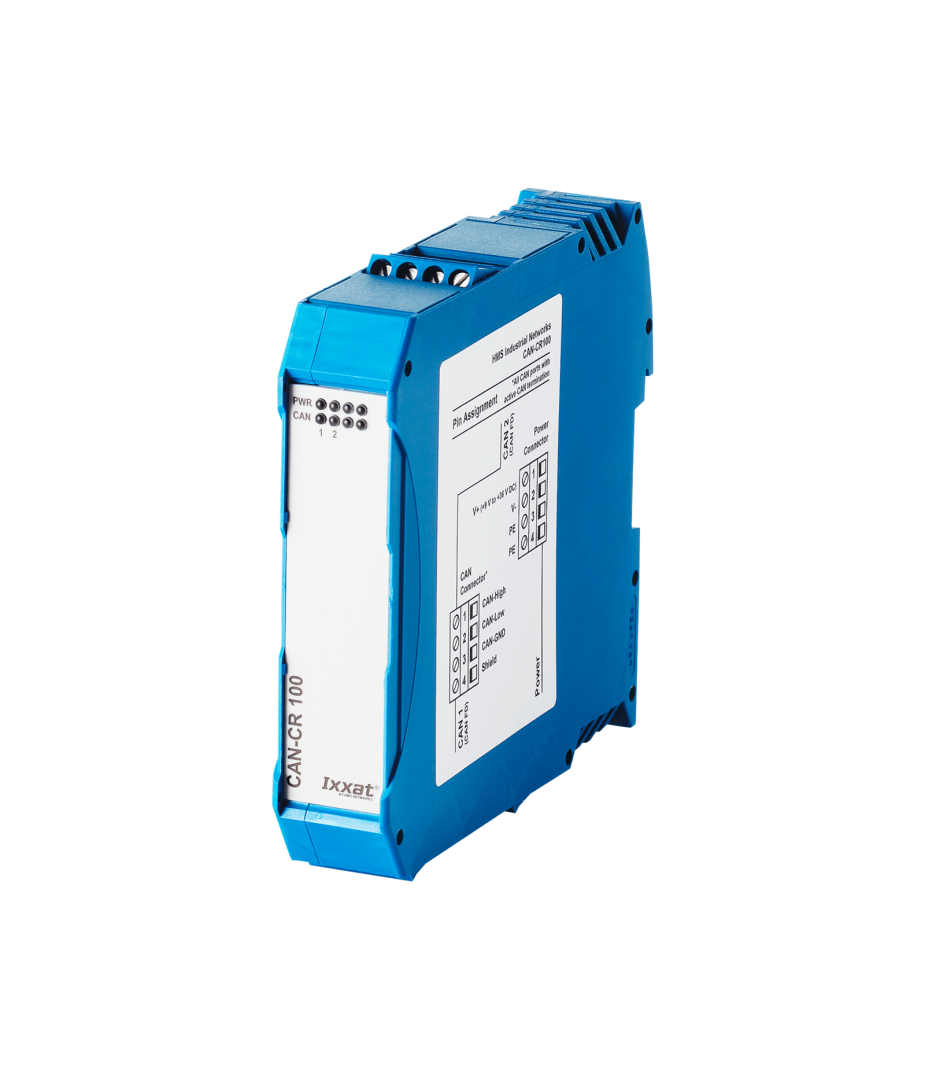
The Ixxat CAN-CR100 is a compact and robust repeater designed to extend CAN and CAN FD networks. In addition, the device improves reliability in industrial environments. First and foremost, this repeater functions as an active link between two network segments. In doing so, the system continuously receives, filters, and amplifies signals. This ensures stable communication, even under high network load. Furthermore, the repeater significantly increases the load capacity of the CAN bus. This is because the system provides galvanic isolation between connected segments. Furthermore, the solution enables a physical connection of different bus systems. This results in more flexible network structures with improved performance. Although traditional CAN topologies have limitations, this repeater largely eliminates those limitations. This creates a more efficient and reliable network.

During a malfunction, the CAN-CR100 repeater automatically disconnects a faulty segment from the network. This ensures that the rest of the communication continues to function. The segment is then automatically reconnected as soon as the fault is resolved. In short, the solution increases both the availability and stability of industrial CAN networks.


Features and benefits

  • Combines 2x CAN FD or CAN in one repeater
  • Robust for industrial use
  • Easy physical integration into CAN networks
  • Simplify and optimise CAN networks
  • Increased system reliability
  • Optional 120 Ω bus termination
  • Galvanic Isolation between network and repeater
  • CAN FD communication up to 4 Mbit/s via screw connectors
  • Cost savings due to simple wiring

Tech Specs

CAN FD Mode

ISO CAN FD (ISO 11898-1)
nonISO CAN FD

CAN FD Baudrate

Arbitration 10 kBit/s … 1 Mbit/s
Data rate max 4 MBit/s

CAN FD Transceiver

Microchip MCP2562FD
 

CAN Mode

CAN high-speed (ISO 11898-2)

CAN Baudrates

10 kBit/s … 1 Mbit/s

CAN Propagation delay

Type 175 ns ( ≈35 m bus )

CAN Termination

Optional 120 Ω bus termination

Galvanic Isolation

Up to 1000 V

Connector

Screw

Power Supply

9~36 V=

Current Consumption

max. 100 mA at 24 V=

Temperature

Usage -20 °C to +70 °C
Storage -40 °C to +85 °C

Dimensions

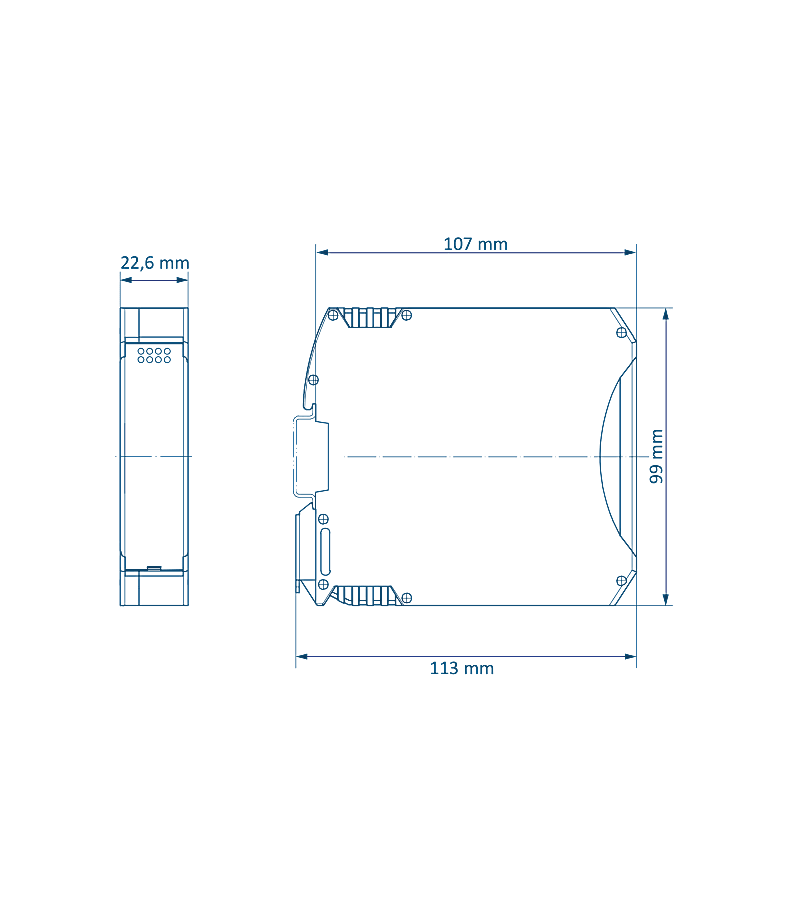
22.5 x 105 x 114 mm

Certification

CE, FCC,

Information

CAN repeaters

Repeaters are used to establish a physical coupling of two or more segments of a CAN bus system. They can be used to implement tree or star topologies as well as for long drop lines. In addition, network segments can be electrically disconnected from each other because all repeaters are galvanically isolated.
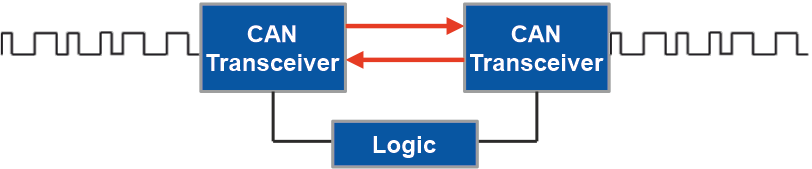
A repeater works much like a line amplifier, amplifying the bits. This makes the operation transparent, ensuring the entire network reacts exactly as before. Repeaters can transmit bits not only electrically, but also via light through a fiber optic (FO) cable.

Advantages

The CAN channels coupled by the repeater are independent electric segments that can be optimally terminated in terms of signals. In this way topologies can be implemented that are not possible with a pure line of the bus due to electrical reflections.
According to the transceiver output capacities, the division of a CAN bus system into several subsystems, connected via CAN Bus Repeaters, increases the maximum number of bus nodes.

Another application of repeaters is the coupling of different physical CAN layers by means of high/low-speed repeaters, optical repeaters, or optical star couplers.

Bus-timing

As signaling is not directed in CAN, the repeater logic has to translate the signals of the segment received into the other and has to ensure that the input signals are not back-coupled. In terms of signals, the repeater corresponds to a line with relevant delay time. Therefore, it cannot be used to extend a CAN bus system.

Using repeaters does not influence the real-time behavior of a system because in terms of transmission behavior it corresponds to a network that consists only of lines.

Conventional bus structure

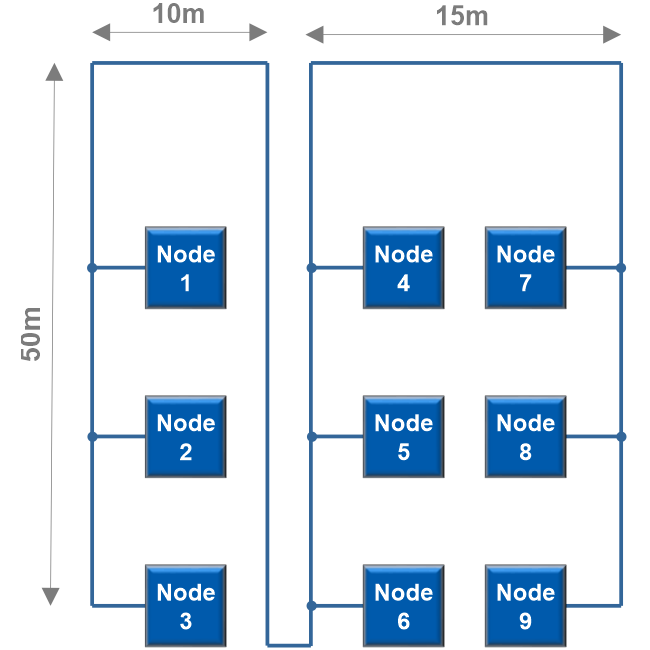
The example below shows a standard CAN bus structure, where all nodes should be connected to the same straight bus. Therefore, the CAN bus makes a U-turn to also connect the nodes in the middle.
The distance between the two nodes furthest apart (1/9) is 220 meters.
Extended bus structure

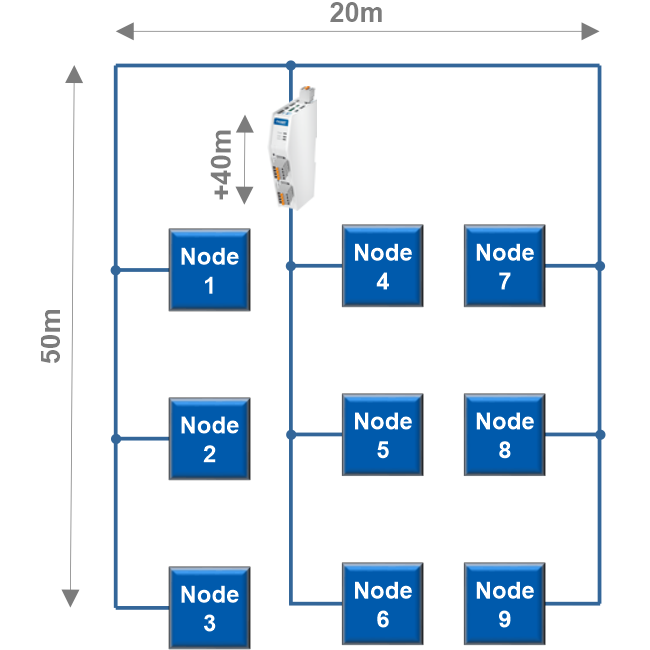
By connecting the middle nodes via a CAN repeater, the U-turn is no longer necessary. Note that the CAN repeater—due to the delay—virtually extends the subsection by 40 m.

The distance between the two nodes furthest apart (either 1/6 or 6/9) is 150 meters.
CAN hub repater

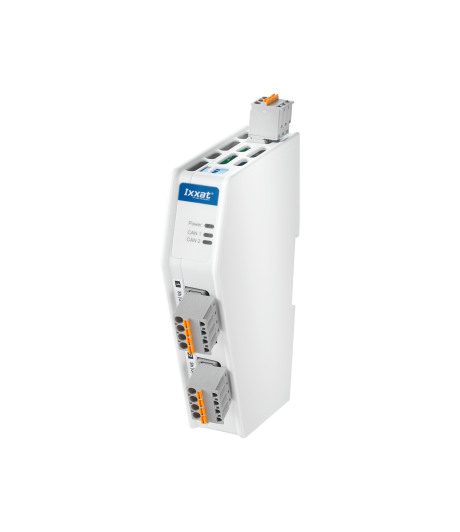
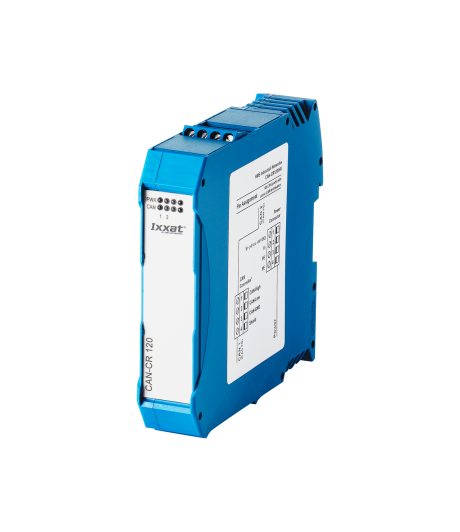
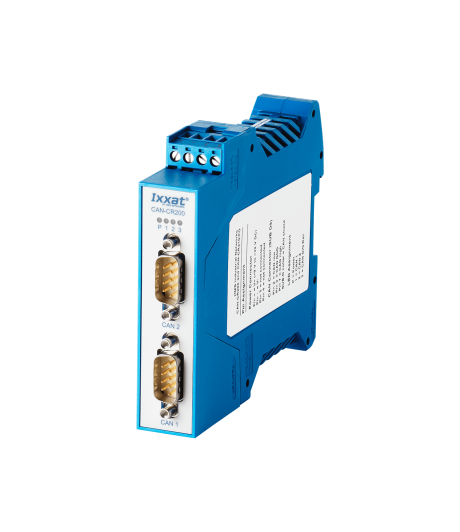
A CAN hub repeater is a typical variant that, in addition to the standard CAN bus connections, also has a CAN port on the rear, between the top headers of a DIN rail. This connection is designed to connect multiple CAN repeaters to a central hub via a backbone bus. It supports the creation of star and tree network topologies, extending the range of the CAN network and simplifying wiring.
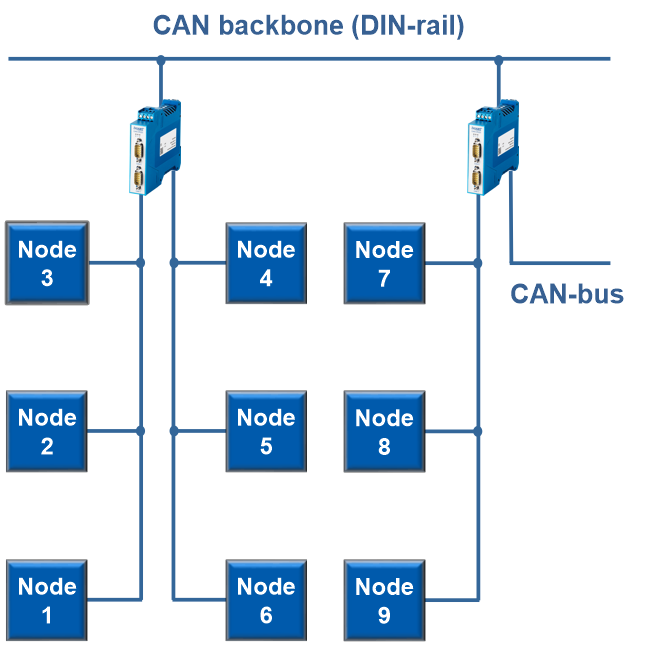
A T-Bus connector is available for these repeaters, which fits into the DIN rail. This connector connects to the CAN port and can be interconnected simultaneously. This creates a backbone of multiple CAN repeaters.
FAQ

  • Are CAN terminating resistors built into the CAN-CR100?

    Optional CAN terminating resistors are built in; these cannot be changed later.

  • How do I choose the right CAN repeater?

    Choosing the right CAN repeater depends, among other things, on the intended application, the desired bus speed and electrical isolation, the length of the network, the acceptable transmission delay, any available installation space, the intended use, and, of course, the available budget.

    Twincomm is a center of expertise for CAN and has over 30 years of experience with CAN. Please contact us and we’ll provide practical advice to help you make the right choice.

  • Does this repeater support CANopen or J1939?

    Yes, the CAN-CR100 works with all CAN messages, including CANopen and J1939

  • Can I order on account?

    Yes, that's definitely possible! Most customers place their orders through a Purchase Order.
    First request a quote and then send the purchase order (PO) by email, simply from your own purchasing system. For first time buyers, we may ask additional questions in order to perform a credit check. Please contact us if you require our company details for registration in the purchasing system.

    For security reasons, customers located in, or wishing to ship to, countries outside the Benelux must always pay in advance.

  • Why are all prices available upon request?

    The online webshop is still under construction. As soon as it is available, all prices will naturally be visible.

    However, everything is of course available, and we would be happy to inform you about prices and delivery times. Please contact us or give us a call. We have over 30 years of experience with CAN. We are happy to help you and offer you immediate practical advice or support.


Part number(s)

1.01.0210.20000 CAN-CR100 - Bus Termination
2x CAN FD, Bus Termination, Galvanic Isolation
Country of Origin: Germany
HS Code: 8517620000
1.01.0210.20200 CAN-CR100
2x CAN FD, Galvanic Isolation
Country of Origin: Germany
HS Code: 8517620000

Scope of Supply

CAN-CR100
  • User Manual 1
1 Available as PDF

Interested?

Are you interested in the CAN-CR100? Request a quote without obligation. Would you like more information? Send an email to -Hidden- or visit our contact page. You can also call us at -Hidden-.
Twincomm has over 30 years of experience with CAN. We are happy to help you and offer you immediate practical advice or support.